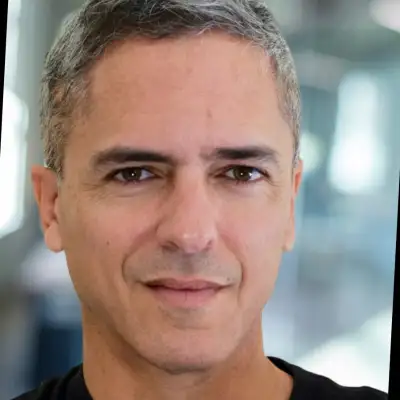
Hardware-Faithful Digital Twins for Quantum Computing with Izhar Medalsy
Summary
Quantum hardware iteration is gated by the simple fact that real QPUs are expensive, scarce, and noisy in ways that generic simulators don't capture. In this episode, Izhar Medalsy, co-founder and CEO of Quantum Elements, explains why the industry is still building "wooden models in the air tunnel" — and how hardware-faithful digital twins, scaled to a distance-7 rotated surface code with 97 physical qubits on AWS HPC, could give pulse engineers, circuit designers, and QEC decoder teams a faster, cheaper place to iterate.Hardware-Faithful Digital Twins for Quantum Computing with Izhar Medalsy
Izhar Medalsy is not a career qubit theorist. His path runs from a physical chemistry PhD and an ETH Zurich postdoc in atomic force microscopy and ternary nanoscale logic, through productizing scientific instruments at Bruker, through building one of the fastest resin 3D printers on the market, into co-founding Quantum Elements in 2023 with Daniel Lidar (USC) and Amir Yacoby (Harvard). That arc — nanoscale measurement scientist turned deep-tech operator — shapes how he thinks about the simulation gap in quantum computing.
The conversation lands at a specific moment. In April 2026, Quantum Elements published a joint result with AWS, USC, and Harvard simulating a distance-7 rotated surface code with 97 physical qubits using full quantum master equations on AWS HPC7a, and announced a deeper collaboration with Rigetti Computing on next-generation superconducting processors. If you care about how error correction strategies, decoders, and pulse-level controls actually get developed before they ever touch hardware, this episode is for you.
EPISODE SPONSOR
This episode is brought to you by Outshift, Cisco's incubation engine. The need for computational power is rapidly increasing in every sector. From drug discovery to material innovation to complex financial modeling, classical systems are reaching their absolute limits. It’s time for a paradigm shift. The answer is a scalable quantum network, built on open standards and vendor-agnostic architecture. By uniting distributed quantum devices, you unlock limitless computational power.
Learn more about the Cisco Universal Quantum Switch at Outshift.com
Go deeper with the blog post The switch that quantum networking has been waiting for
====================================================================================================
What We Get Into
- Why generic noise models fall short and what "hardware-faithful" actually means when two nominally identical QPUs have different noise fingerprints
- How Quantum Elements scaled open-system master-equation simulation from a brute-force ceiling around 16 qubits to 97 qubits using stochastic compression on top of Quantum Monte Carlo
- The compute reality of the distance-7 surface code run on AWS HPC7a — only 96 vCPUs and a few hundred gigabytes of memory, not the thousands of vCPUs they initially feared
- Why decoders are the invisible bottleneck in fault tolerance, and where AI-trained decoders fed by digital twin data could plausibly run inside the real-time quantum-classical loop
- Extending error suppression from physical qubits up to logical qubits — the IBM Eagle work where digital-twin-guided strategies reportedly took entangled logical qubit fidelity from 43% to 95%
- How the same digital twin approach extends to neutral atoms (live today) and ion traps (on the roadmap)
- What Rigetti gets out of the partnership, what it means to have Chad Rigetti on the board, and how Constellation fits alongside real hardware time
- Izhar's "wooden models in the air tunnel" critique of how the quantum industry currently iterates — and what a parallel virtual development track buys you
Resources & Links
Guest & Company
- Izhar Medalsy — Quantum Elements team page — Background and role at Quantum Elements.
- Izhar Medalsy on LinkedIn — Full career arc from ETH biophysics through 3D printing to quantum.
- Quantum Elements — Constellation platform, where listeners can build their own virtual QPU and run circuits, error suppression, and QEC experiments.
Papers & Articles
- AWS Quantum Computing Blog: Decoding realistic QEC syndrome with Quantum Elements digital twins — Primary technical reference for the 97-qubit distance-7 result discussed in the episode.
- The Next Platform: How HPC and AI Digital Twins Accelerate Quantum Error Correction (Apr 17, 2026) — Independent reporting on the AWS/USC/Harvard simulation.
- The Quantum Insider: Quantum Elements & Rigetti collaboration (Apr 21, 2026) — Details on the partnership Izhar describes.
- Guest post: Quantum Digital Twins — The Missing Acceleration Layer — Izhar's own framing of the thesis.
- The Next Platform: Startup Profile of Quantum Elements (Jan 2026) — Background on the company.
- arXiv 2603.14607 — Calibration-Based Digital Twins for IBM Quantum Hardware — Useful independent context on the limits and promise of calibration-based twins.
Key Quotes & Insights
- "Sometimes when I look at the quantum industry, there are instances where you think, well, it's almost like building the next fighter jet with wooden models in the air tunnel." — Izhar's framing for why the field needs a real simulation layer.
- On hardware awareness: each modality, each QPU, sometimes each calibration cycle has its own pulses, its own noise processes, and its own failure modes. You cannot build the control stack without modeling where you are starting from and where you are trying to get to.
- Insight: The brute-force ceiling for open-system master-equation simulation is roughly 16 qubits. Stochastic compression layered on Quantum Monte Carlo is what let Quantum Elements reach distance-7 surface code at 97 qubits — exploiting sparsity rather than enumerating the full state space.
- On logical qubits: "We cannot assume that logical qubits will be noise-free." Error suppression strategies developed at the physical level need to be re-derived at the logical level, and digital twins are how you train and test those strategies before hardware.
- Insight: The most interesting downstream story may not be simulation itself but AI decoders trained on digital-twin-generated data — small enough to run at the edge, fast enough to live inside the real-time quantum-classical loop.
Related Episodes
- Episode 52 — Quantum noise with Daniel Lidar — Quantum Elements' co-founder and CSO on the noise suppression and error correction foundations underneath this work.
- Episode 56 — Bridging Theory and Experiment in Quantum Error Correction with Liang Jiang — A complementary view on the gap between idealized QEC and what hardware actually does.
- Episode 81 — Quantum LDPC error correction with Larry Cohen and Paul Webster — For listeners who want to go deeper on the codes that digital twins increasingly need to model.
- Episode 84 — Engineering the Quantum Future with Brian Gaucher — A systems-engineering counterpart to Izhar's "wooden models in the air tunnel" critique.
- Episode 71 — Macroscopic Quantum Tunneling with Nobel Laureate John Martinis — Martinis' systems-thinking framing that Izhar explicitly nods to in the conversation.
Stay in the Ecosystem
- Subscribe on Apple Podcasts, Spotify, YouTube, or Amazon Music.
- Get the newsletter and full episode archive at newquantumera.com.
- Follow the show on LinkedIn and Bluesky.
- Try Quantum Elements' Constellation platform at quantumelements.ai — build your own virtual QPU and run circuits, error suppression, and QEC experiments.