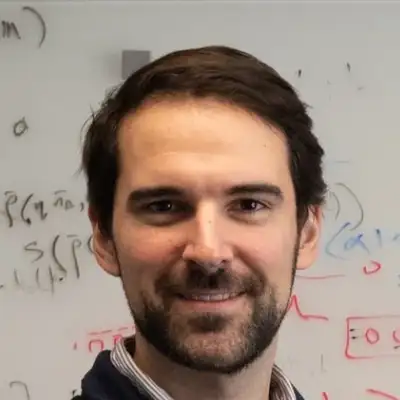
Quantum Cameras and Sub-Diffraction Imaging with Johannes Galatsanos
Summary
What if a camera could skip the JPEG entirely and process photons at the speed of light, extracting information that conventional optics leave on the table? Diffraqtion co-founder and CEO Johannes Galatsanos joins Sebastian to explain how a quantum-inspired imaging device — built on quantum Fisher information theory — can see beyond the diffraction limit and run neural network classifications directly in the photonic domain. It's a candid conversation about what "quantum" really means in quantum sensing, why space is the first market, and what quantum sensing needs to break out of quantum computing's shadow.Johannes Galatsanos occupies an unusual dual perch in the quantum ecosystem. As a co-author of the inaugural MIT Quantum Index Report, he's helped map the entire quantum landscape at altitude; as co-founder and CEO of Diffraqtion, he's staked his career on one of its most under-discussed corners: quantum imaging. The company spun out of Saikat Guha's lab at the University of Maryland after more than a decade of DARPA-funded research, emerged from stealth in January 2026 with $4.2M in pre-seed funding, and is now racing toward on-sky telescope demonstrations and a 2028 satellite launch.
This episode is for listeners who want a technically honest look at where the "quantum" label is doing real work in a sensor versus where it's shading into sophisticated photonics and analog computing. If you care about how quantum technologies actually reach the world — through markets, contracts, and hardware that ships — this conversation gives you a specific, concrete example to think with.
What You'll Learn
- Why a conventional camera can lose roughly 95% of the information a photon carries, and what quantum Fisher information theory says about recovering it
- How Diffraqtion's device processes light directly in the photonic domain before converting it to electronic information — and why that matters for shot noise
- The honest answer to "is this really quantum?" — including where the technology sits between quantum information theory, photonics, and analog computing
- Why a 6U CubeSat with a 10-centimeter aperture can plausibly compete with school-bus-sized observation satellites for specific tasks
- How a "diffractive neural network" runs image classification at the speed of light with negligible power consumption
- The difference between Diffraqtion's hard-coded Gen 1 camera and the reprogrammable Gen 2 that can swap algorithms in orbit (canopy detection over the Amazon, ship detection over the Atlantic)
- Why the Habitable Worlds Observatory needs a coronagraph capability — and how you can build one by processing light rather than blocking it
- What quantum sensing needs from policy, capital, and PR to escape the shadow of quantum computing
Resources & Links
Guest & Company
- Diffraqtion — Company homepage; describes the technology, NASA/DARPA lineage, and the "quantum eye" framing referenced in the conversation.
- Johannes Galatsanos on LinkedIn — Recent activity including SmallSat Europe, the NASA Space to Soil Challenge, and GQIG Summit talks on quantum imaging.
Papers & Reports
- Quantum Index Report 2025 (arXiv) — The preprint of the MIT QIR, co-authored by Galatsanos. Essential reading for anyone trying to see the quantum landscape as a whole.
- MIT Sloan — New MIT Report Captures State of Quantum Computing — Background on the QIR and Galatsanos's research role at the MIT Initiative on the Digital Economy.
- MIT Sloan — Quantum Report Charts Growing Business Interest — Further QIR findings on the growth in corporate quantum mentions.
Press & Coverage
- Diffraqtion Pre-Seed Announcement (PR Newswire) — Official release covering the $4.2M raise, DARPA contract, and founding team.
- Breaking Defense — DARPA Backs Diffraqtion — The most in-depth interview on the DARPA SBIR contract and programmable light plates.
- The Quantum Insider — Diffraqtion $4.2M Raise — Investor context including quotes from Chad Rigetti; technical claims on resolution and processing.
- Payload Space — Diffraqtion Emerges from Stealth — Commercial framing around the 6U CubeSat cost model.
- Defense One — Quantum Cameras Could Remake Space-Based Intelligence — Policy and defense framing.
Sponsor
- Cisco Universal Quantum Switch — Outshift by Cisco — Cisco's incubation engine, building a scalable quantum network on open standards and vendor-agnostic architecture.
Key Quotes & Insights
- On quantum information loss: "When you do a direct image… you lose something like 95% of information from that photon. So you leave 95% on the table, and the question was: how do you extract that back?"
- On what "quantum" really means here: Galatsanos is refreshingly candid — the device uses quantum Fisher information theory to set the physical limit and configure the hardware, but the runtime processing is closer to analog photonic computing than to gate-based quantum computing. He describes it as sitting between "quantum 1.0" and quantum sensing.
- On the frog's-eye analogy: Retinal ganglion cells can process shapes and trajectories faster than the brain — which is why you can catch a baseball or a falling fork before you consciously see it. Diffraqtion is trying to give satellites and robots the same kind of reflex.
- On the JPEG as a historical artifact: "JPEG was a little bit of a logical step… but now the thought is, forget about it — you don't even need that. The light itself already will tell you." The machine, unlike a human operator, doesn't need an image.
- On why quantum sensing lags in the discourse: Insight — quantum computing benefits from a single unifying narrative that every vendor can pull on. Quantum sensing has to invent its own story from scratch for each modality, which is a structural PR disadvantage more than a technical one.
Related Episodes
- Ep. 65 — Quantum sensitivity breakthrough with Eli Levenson-Falk — On protocols that push measurements beyond conventional limits; a natural companion to the Fisher information discussion.
- Ep. 16 — Operating at the Quantum Limit with Dr. Dana Anderson — Infleqtion's CSO on quantum sensing alongside computing; useful context for why sensing is closer to deployment.
- Ep. 68 — Incubating quantum innovation with Vijoy Pandey of Outshift by Cisco — On quantum networks solving real problems today; a parallel to Diffraqtion's near-term deployment argument.
- Ep. 63 — A Programming Language for Quantum Simulations with Xiaodi Wu — Also from the University of Maryland ecosystem that produced Diffraqtion's core research.
Stay in the Ecosystem
- Subscribe: Apple Podcasts · Spotify · YouTube · Amazon Music
- Newsletter & archive: newquantumera.com — writing and analysis between episodes.
- Follow: LinkedIn · Bluesky
- Share this episode with someone who's still tracking only the computing side of quantum. Quantum sensing needs an audience.
Sponsor
This episode is brought to you by Outshift, Cisco's incubation engine. The need for computational power is rapidly increasing in every sector. From drug discovery to material innovation to complex financial modeling, classical systems are reaching their absolute limits. It's time for a paradigm shift. The answer is a scalable quantum network, built on open standards and vendor-agnostic architecture. By uniting distributed quantum devices, you unlock limitless computational power.
Learn more about the Cisco Universal Quantum Switch at Outshift.com.
Go deeper with the blog post The switch that quantum networking has been waiting for.