Silicon Spin Qubits and the IBM–HRL Acquisition with Thaddeus D. Ladd
Summary
IBM's pending acquisition of HRL Laboratories is the biggest structural move in quantum hardware in years — but the announcement names sensing, networking, cryogenics, control electronics, and packaging alongside silicon spin qubits. Thaddeus D. Ladd, Chief Scientist of HRL's Computational Physics Division, joins Sebastian to explain what HRL has actually built, why the 2026 QPU paper may matter more for its integrated control stack than its qubit fidelity numbers, and what it means for the future of quantum hardware when one storied industrial research lab acquires another.Thaddeus Ladd has spent seventeen years at HRL as the theoretical anchor of its silicon spin qubit program — co-authoring the 2023 Nature paper that demonstrated universal logic with encoded spin qubits, and contributing to the 2026 QPU paper that integrated qubits, a cryo-CMOS controller, and a new superconducting ribbon cable into a single digitally controlled system. He is not a commentator on this acquisition; he is one of the people whose work made it happen.
The conversation is recorded eleven days after IBM announced a definitive agreement to acquire HRL from Boeing and General Motors — a deal that has not yet closed. That timing makes this one of the few technically grounded, insider-adjacent conversations available about what IBM is actually buying, why the exchange-only spin qubit architecture is strategically distinctive, and what the combination of HRL's research culture with IBM's fabrication ambitions could produce. Listeners who follow quantum hardware, quantum computing strategy, or the evolution of industrial research labs will find this episode unusually substantive.
What We Get Into
- Why the 2026 QPU paper is a systems story, not just a fidelity story — the qubit chip, the cryo-CMOS controller operating at four Kelvin, and the new superconducting ribbon cable are all part of one integrated QPU, and that framing is central to understanding what IBM acquired.
- What "exchange-only" actually means — why using only voltage-controlled exchange interactions (no microwaves, no local oscillators, no phase tracking during idle) is both a technical constraint and a significant engineering advantage for scaling.
- Why the jump from six dots to fifty-four dots happened so fast — and what was happening in HRL's fabrication program that wasn't being published.
- What EUV lithography has to do with spin qubit scaling — and why the connection between HRL's process and IBM's Anderon 300 mm quantum foundry is one of the clearest pieces of strategic logic in the acquisition announcement.
- How HRL's cryo-CMOS work could benefit IBM's superconducting program — and why the control-and-interconnect bottleneck is a shared problem across modalities, not a spin-qubit-specific one.
- The "chandelier" reframe — Thaddeus's argument that the cables, filters, and control electronics surrounding a superconducting qubit chip are not overhead; they are part of the QPU, and understanding that changes how you read the HRL acquisition.
- Which modality Thaddeus thinks will reach commercially useful scale first — and why he still believes spin qubits are the long-term answer, using an analogy to vacuum tubes and silicon microprocessors that is worth hearing in full.
- What the acquisition means for HRL as an institution — the context of lost program funding, the December 2025 Q2B meeting, and what it means for a defense-oriented industrial research lab to find a commercial path through IBM.
Resources & Links
Guest
- Thaddeus D. Ladd — Personal Website & Publications — Self-curated, annotated bibliography; the best single source for his research arc across spin qubits and quantum communication.
- Thaddeus Ladd — Hertz Foundation Profile — Biographical overview of his career and role at HRL.
- Thaddeus D. Ladd — Google Scholar — Full citation record.
Papers & Articles
- A Digitally Controlled Silicon Quantum Processing Unit — arXiv (April 2026) — The QPU paper discussed at length in this episode: 54-dot device, cryo-CMOS controller at 4 K, superconducting ribbon cable, and error correction experiments — all working as one integrated system.
- Universal Logic with Encoded Spin Qubits in Silicon — Nature (2023) — The landmark result demonstrating universal logic with exchange-only encoded qubits; Ladd was co-author and lead theorist.
- Two-Dimensional Si Spin Qubit Arrays with Multilevel Interconnects — PRX Quantum (2025) — Scalable 2D spin-qubit arrays achieving greater than 99.9% single-qubit gate fidelity; the step between the 2023 and 2026 results.
- Silicon Encoded Spin Qubits Achieve Universality — HRL (2023) — HRL's public announcement of the Nature result; accessible summary for non-specialists.
- Semiconductor Spin Qubits: The Certainty of Progress — HRL (December 2025) — HRL's public framing of the platform's trajectory, published shortly before the Q2B meeting where Sebastian and Thaddeus first met.
Acquisition & IBM Strategy
- IBM to Acquire HRL Laboratories — IBM Newsroom (July 23, 2026) — The definitive transaction announcement; names the full scope of what IBM says it is acquiring.
- IBM to Acquire HRL Laboratories — HRL Laboratories (July 23, 2026) — HRL's concise confirmation of the deal and the beginning of regulatory review.
- What Are Spin Qubits? — IBM Quantum (July 23, 2026) — IBM's technical explanation of HRL's Si/SiGe exchange-only qubits and the shared silicon fabrication argument.
- A Brief History of HRL Laboratories — IBM Research (July 23, 2026) — IBM's institutional framing of HRL, including its history with the laser, self-aligned-gate MOS fabrication, and the 2026 spin-qubit QPU.
- IBM and U.S. Department of Commerce Announce Anderon Quantum Foundry (May 21, 2026) — The 300 mm quantum foundry announcement that Thaddeus identifies as one of the clearest pieces of strategic logic behind the HRL acquisition.
- IBM Commits More Than $10 Billion to Quantum Computing (June 2, 2026) — Capital context for the acquisition: R&D, manufacturing scale-up, M&A, and ecosystem investment over five years.
Tools & Platforms
- spinQICK — GitHub — HRL's open-source FPGA-based spin-qubit control toolkit; a concrete artifact of HRL's approach to open tooling.
- HRL Launches Open-Source spinQICK — HRL (July 2025) — Announcement and context for the spinQICK release.
- HRL Quantum — Collection of HRL quantum research, talks, and news.
Organizations
- Q-NEXT: Thaddeus Ladd Collaborates on Quantum Communication — Profile of Ladd's role as co-design engineer for Q-NEXT's Quantum Communication Thrust and his silicon carbide photonics work.
- Q-NEXT: Quantum Innovation at HRL Laboratories — Describes Ladd's quantum technology roadmapping leadership within Q-NEXT.
Key Quotes & Insights
On why the meeting context matters: > "That was the week after HRL lost significant program funding. It was the first time I had ever gone to Q2B, and it was at a time when we knew that the next step for HRL and HRL's brand of spin qubits was commercialization."
On the QPU as a system, not a chip: > "We think of the controller, the interconnect to the qubits, and the qubits all together as a QPU. Once you do that, then yes — our entire QPU is, first of all, cold, and second of all, only accessed with digital signals."
On the chandelier reframe: > "I want to correct them, because you don't get a quantum computer in that tiny little box unless you have all of those cables and filters and isolators, and the racks of electronics that sit behind them. Those are part of the quantum processing unit."
Insight — on which modality reaches market first: Thaddeus says superconducting qubits are most likely to be first to commercially useful scale, because they don't require the same fabrication infrastructure development that spin qubits do. But he believes spin qubits are the long-term answer — the silicon microprocessor to superconducting qubits' vacuum tube.
Insight — on why the progress looks sudden: The jump from six dots to fifty-four dots, and from ~97% to much higher fidelity, reflects parallel generations of work that were happening inside HRL but not being published. The pace of publication increased; the pace of the underlying work did not change as dramatically.
Related Episodes
- Ep. 83 — Quantum Engineering with David Reilly and Tom Ohki — Reilly and Ohki discuss building scalable quantum computing infrastructure through cryo-CMOS; directly relevant to the control-stack discussion in this episode.
- Ep. 84 — Engineering the Quantum Future with Brian Gaucher — IBM quantum engineer Gaucher explains why engineering challenges, not physics, are the critical path; a useful companion to Thaddeus's systems framing.
- Ep. 59 — Silicon Spin Qubits with Andrew Dzurak from Diraq — Dzurak discusses a different approach to silicon spin qubits and manufacturing on standard CMOS processes; good context for comparing architectures.
- Ep. 49 — Quantum Control with Yonatan Cohen — Quantum Machines CTO discusses scaling quantum control systems; relevant to the cryo-CMOS and interconnect challenges Thaddeus describes.
- Ep. 5 — The History of Superconducting Qubits with Steve Girvin — Useful background on the superconducting program that HRL's spin-qubit work will now sit alongside inside IBM.
Stay in the Ecosystem
- Subscribe on Apple Podcasts, Spotify, YouTube, or Amazon Music.
- Sign up for the newsletter at newquantumera.com — the best way to follow quantum hardware developments without sorting through the hype yourself.
- Follow NQE on LinkedIn and Bluesky.
- If this episode helped clarify what IBM is actually building, or gave you a clearer picture of where silicon spin qubits stand, share it with someone who follows quantum hardware.
---
Creators and Guests
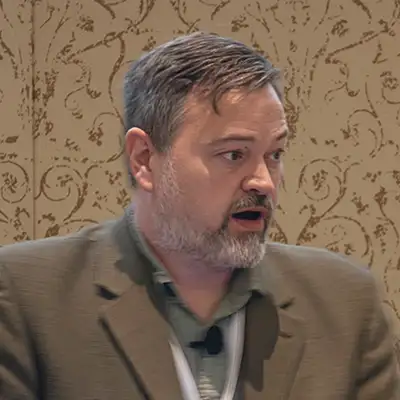
Guest
Thaddeus D. Ladd
Chief Scientist of the Computational Physics Division at HRL Laboratories, and head of the Quantum Theory and Simulation department