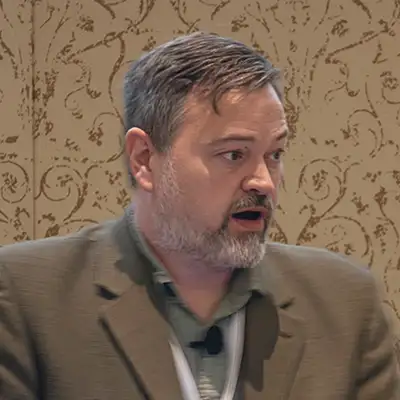
Silicon Spin Qubits and the IBM–HRL Acquisition with Thaddeus D. Ladd
Summary
IBM's pending acquisition of HRL Laboratories is the biggest structural move in quantum hardware in years — but the announcement names sensing, networking, cryogenics, control electronics, and packaging alongside silicon spin qubits. Thaddeus D. Ladd, Chief Scientist of HRL's Computational Physics Division, joins Sebastian to explain what HRL has actually built, why the 2026 QPU paper may matter more for its integrated control stack than its qubit fidelity numbers, and what it means for the future of quantum hardware when one storied industrial research lab acquires another.Sebastian Hassinger • 00:02
This is The New Quantum Era. I'm your host, Sebastian Hassinger.
I want to tell you how this episode came together, because the backstory matters.
I met Thaddeus Ladd at Q2B in Silicon Valley last December — and I want to be precise about that, because Thaddeus corrected me on it during the recording, and the correction turns out to be important. That December meeting happened the week after HRL had lost significant program funding. Thaddeus was there, in part, to figure out what commercialization might look like for a spin-qubit program that had been running, largely out of public view, for more than fifteen years inside a defense-oriented industrial research lab jointly owned by Boeing and General Motors.
We started scheduling a conversation. The plan was to dig into HRL's spin-qubit work — specifically the results Thaddeus was about to present at the APS March Meeting, which I surmised was going to be a significant step forward in fidelity and system integration. And then, eleven days before we recorded, IBM announced that it had signed a definitive agreement to acquire HRL Laboratories. The whole thing. Not just the quantum program — the entire institution, including work on IR cameras, radar, autonomous navigation, and advanced materials that you would not immediately associate with IBM.
So the conversation shifted.
Thaddeus D. Ladd is Chief Scientist of HRL's Computational Physics Division and head of Quantum Theory and Simulation. He has been at HRL for seventeen years. He was a co-author and lead theorist on the 2023 *Nature* paper that demonstrated universal logic with encoded spin qubits in silicon — a result that had been a theoretical target since the year 2000. And he was a key contributor to the paper published just last week, which describes what HRL calls a digitally controlled quantum processing unit: a 54-dot device, a custom cryo-CMOS controller operating at four Kelvin, and a new superconducting ribbon cable connecting the two — all working together to run error correction experiments.
That paper is worth pausing on, because one of the things I wanted to explore with Thaddeus is whether the most strategically important thing in it is actually the qubit fidelity numbers — which are impressive — or whether it's the integrated stack around the qubits: the cryo controller, the high-density interconnect, the packaging. Because IBM's acquisition announcement is conspicuously broader than a qubit-modality announcement. It names sensing, networking, materials, cryogenics, controls, interconnects, and packaging alongside spin-qubit computing. And it explicitly connects HRL to Anderon, IBM's proposed 300 mm quantum foundry.
So what is IBM actually buying? A second path to fault-tolerant computation? A systems integration capability that benefits every modality? A research institution with a culture and a mission that IBM's capital can finally scale? We get into all of it.
Thaddeus is also quite candid about where spin qubits stand relative to superconducting systems — including his view of which modality is most likely to reach commercially useful scale first, and why he still believes spin qubits are the long-term answer. The analogy he reaches for is a good one, and I'll let him make it.
The acquisition has not yet closed. Thaddeus is still an HRL employee. There are things he can't discuss. But what he can discuss is technically serious, historically grounded, and genuinely illuminating about one of the most consequential moves in quantum hardware in years. Oh, and one last thing — we had some technical issues on the recording, and I've had to do a bit more editing than normal thanks to some smartphone and wireless networking gremlins. Hopefully none of it will be too distracting to your listening pleasure.
Here's my conversation with Thaddeus D. Ladd.
Sebastian Hassinger • 04:42
Thaddeus, hello. Thank you very much for joining me. I've been looking forward to this conversation for quite some time.
We met at IEEE Quantum Week last September, and I immediately knew I wanted to have you on the podcast. We started talking about scheduling something around the time you were getting ready for the APS March Meeting, and the research you were going to present there was another big step forward for spin qubits — I was super excited to hear about it.
And then eleven days before the day of this recording, IBM announced that they'll be acquiring HRL, which is quite the seismic event in the quantum industry. So that changed my approach to this conversation, bearing in mind that the acquisition is announced and not closed, and there are all kinds of things that are either unknown or can't be spoken of until the deal is finalized.
I would just love to hear from you, at least impressions, of what it means that IBM is buying HRL.
Thaddeus Ladd • 05:59
Well, first of all, Sebastian, it is truly my delight to be here. I do have to correct you — and normally I wouldn't correct you, but it's actually pertinent to your question. We did not meet at IEEE Quantum Week in September. We met at Q2B Silicon Valley in December.
And the reason that's an important detail is because that was the week after HRL lost significant program funding. It was the first time I had ever gone to Q2B, and it was at a time when we knew that the next step for HRL and HRL's brand of spin qubits was commercialization — from what we were before, which was a lot of different government programs really on a research but non-commercial track, into the commercial sector. Part of the reason I was at Q2B, and part of the reason I even met you, was figuring out what that would mean. So that backdrop, I think, is pretty important to the question.
What does IBM announcing a definitive agreement to acquire us actually mean? It means that finally, in the seven months since that meeting, we have a real and super exciting track to take this technology we've been working on for a long period of time and inject it into a commercial entity. IBM is obviously among the very first and, in my opinion, the strongest toward market commercialization of quantum computers. And so I'm super excited to get to keep working on spin qubits in that context.
Sebastian Hassinger • 08:04
That's important context, you're right. And it's interesting because in a way, IBM Research — which is the progenitor of IBM Quantum — is one of the few last remaining labs from the golden age of industrial R&D, along with the obvious ones, Bell Labs et cetera. And I think of HRL as being in that category as well.
Thaddeus Ladd • 08:36
Yeah, absolutely. We would say the same thing about HRL. It's the new, or the remaining, Bell Labs — a golden-age research lab.
And some people who have that impression feel like, oh no, we've lost yet another of the independent golden-age labs, because we're being — if the deal goes through — fully acquired by IBM Research. And that means not just quantum, that means everything that HRL does. Things like IR cameras and radar, any number of things that you might not immediately associate with IBM, but of course are very valuable research directions in their own right.
So it's a little bit of an end of an era for what used to be Hughes and then was HRL for many, many years. But it's a new era. It's a new quantum era.
Sebastian Hassinger • 09:39
Oh, a plug! You worked it in. Thanks, I appreciate that.
So take us back a bit to spin qubits at HRL. Has the focus in HRL's program for quantum information and quantum technology always been primarily spin-qubit focused?
Thaddeus Ladd • 10:04
Well, let's see. I've been at HRL for now seventeen years — sixteen and a half. I arrived in late 2009, and I came to HRL specifically to work on silicon/silicon-germanium spin qubits. So that has always been the key quantum technology at HRL. It's the reason most people who are at HRL are here. There have been different programs over the years, of different sizes.
That isn't to say it's the only thing HRL Quantum does. There is a quantum optics effort here, so you might say we make photonic qubits. There is an effort to make defect qubits in silicon carbide. Those are smaller efforts, for sure, and less the focus — and they're not so much heading toward quantum computing, but toward other quantum technologies: sensing, communication, et cetera.
As one example, HRL is presently co-owned by Boeing, and Boeing has a mission called Q4S to launch a satellite doing entanglement swapping in space. HRL is basically testing and putting together the payload for that mission. So that's a quantum optics effort that happens here.
I've been somewhat connected to all of these efforts, but the primary focus — and certainly the largest programs — have been in the specifically exchange-only silicon/silicon-germanium flavor of spin qubits.
Sebastian Hassinger • 11:48
Explain for the listeners what "exchange-only" means in the context of your spin qubits.
Thaddeus Ladd • 11:55
Yeah, happy to do so. Maybe I'll approach it somewhat historically.
The proposals for how to make spin qubits go back a long time. In fact, the key identified moment of birth of spin qubits is, coincidentally, the very time that I went to grad school at Stanford — that's late 1998 and early 1999, when two papers came out. One from Bruce Kane, about making spin qubits using phosphorus in silicon, and another from Daniel Loss and David DiVincenzo, the so-called Loss-DiVincenzo paper.
What the Loss-DiVincenzo paper's most valuable chunk of physics was, was the exchange interaction. Which says: look, if you've got two electrons in quantum dots, you can push those two electrons close to one another just with voltages. And when that happens, one particular spin state — the so-called singlet spin state, the antisymmetric one — lowers in energy relative to a higher one. And in that way you're able to control something about the spin of electrons using voltages.
Now, zipping forward twenty-some years, the reason that's exciting is because voltage is what we most easily control with transistors, with CMOS, et cetera. But spin — especially in silicon, which is a very clean and low-noise environment — is how you want to house quantum information in a device.
So, depending on how technical we want to get: in the Loss-DiVincenzo paper, one spin was a two-level system, and then two-qubit gates would be done with exchange. But the way we do qubits is with exchange only, which is beneficial because it means the only interaction we have to use is this one that's controlled by voltages and therefore very friendly to CMOS.
A cost — I don't know if it's a cost, maybe it's a feature — but an aspect of doing this is that we no longer get control over a single spin. We only get control over differences in spin, these so-called subspaces of many spins in an array.
So the way we most often deal with this is to have three spins in three separate quantum dots. One particular angular momentum state of those three spins is one qubit level, and another angular momentum state of those three spins is the second qubit level. And they're actually degenerate, meaning they have the same energy — meaning there's no clock. They're not evolving when you aren't turning on interactions.
And that's also important for electronics. It means you don't have to have precision clocks. You don't have to have a local microwave oscillator that's tracking what each individual resonator or spin or whatever it is — what its phase is, et cetera. There is no phase evolution while things are idle. So you're only ever applying these DC baseband voltages, and yet you're able to have access to this very coherent spin degree of freedom.
That's the essence of exchange-only.
Sebastian Hassinger • 15:39
And is that the basis of the paper from 2023 that laid out the universal logic? Was that exchange-only, that scheme you just described, that was part of that research?
Thaddeus Ladd • 15:51
Correct. Again, historically, the first important paper for exchange-only — well, perhaps the first one came from Dave Bacon and co-workers, but a really important one was published by David DiVincenzo, who notably was at IBM. And that showed that not only do you have a single qubit with these triple-dot, triple-spin exchange-only things, but it showed a very concrete, finite pulse sequence for doing a CNOT gate. Again, that's the year 2000, so that's twenty-six years ago as a theoretical proposal. And then it had some technical issues that were resolved by a paper out of HRL in 2010.
But then, of course, we had to actually implement it. There was some work in exchange-only done in gallium arsenide by Charlie Marcus, Jim Medford, folks like that. But that was the target for HRL starting in 2009, and for me starting in 2009.
And in 2022, I guess, we published the first actual instantiation of one of these two-qubit gates with spins across six dots. There was the seminal paper from DiVincenzo which showed how to do a CNOT gate with two of these encoded triple-dot qubits, an important addition or correction to it happened in 2010, but it wasn't until 2022 that we published an actual performance of that in *Nature*.
Now, that paper was not great fidelity. I can't remember what it was — something like 97%. And that was in a device that only had six dots in it, so just enough to house two of these triple-dot qubits. From the external point of view, it would look like a bare minimum to show a proof of principle for this sort of two-qubit gate.
So it maybe comes as a little bit of a surprise that a paper published just last week, not terribly long from that one, somehow has fidelity better by multiple orders of magnitude, and 54 dots, and so on.
Sebastian Hassinger • 18:22
Yes, it's quite the leap. I assume that's indicative of a bunch of work that was happening in the background that just wasn't ready yet for publication.
I guess my question would be: spin qubits have always been the "someday" technology modality, right? Like — imagine if we could make qubits that leverage all the scaling and precision engineering benefits of CMOS. Wouldn't that be nice? And as you said, the first papers that proposed it are twenty-five plus years ago.
Is that leap from six dots to fifty-four dots indicative of you beginning to be able to leverage the advantages of CMOS? Are we off to the races, so to speak?
Thaddeus Ladd • 19:16
Well, let's see. From my point of view, having worked in this field for a quarter of a century, silicon-based spin qubits have always been the way. It was just a matter of getting the resources together to fab the thing.
There's also a lot that we had to learn. I mean, I mentioned the Loss-DiVincenzo papers and the Kane proposal papers — neither of those papers had fully formed proposals. Phosphorus in silicon is still a way of moving forward; it's what SQC is working on. Loss-DiVincenzo qubits are a thing — most of the startups that exist in spin qubits are working on Loss-DiVincenzo-style qubits. But even those do not use the measurement elements and other aspects of those original proposals. There's a lot to learn.
But other than the obvious having to learn how to deal with noise and other things, mostly the obstacle has been getting the right resources together for fabrication and process development. The promise of CMOS and silicon microelectronics in general is that once you know how to print three trillion transistors on a 300-millimeter wafer with super high yield, now you are able to just spit out chips and make tons of money from them, because the cost of printing the next one — the second wafer, the third wafer — is very, very small.
Unfortunately, the cost of printing that very first one is quite large, and it takes a lot of time. And that, of course, needed to happen with spin qubits more so than any other modality. Superconductors are huge — so much easier to develop processes for than that. But even when you're using some new material, tantalum or whatever, and traps for ions or something — yeah, those are possibly fabbed on silicon, but still with very, very large structures. To make things that are very, very small pitch, and large, and very high yield takes a lot of development money.
So that needed to happen over those twenty-five plus years, including the resources for it to happen. And a lot of what was happening at HRL in that direction was of course not well publicized. I mean, it still isn't today. I'm not going to detail with you all of the fabs that the chips that went into that *Nature* paper went through. It was a lot, but it's been happening consistently in the background. And it's really those events leading to our meeting in December, and other things, that allowed us to get the more recent paper out the door.
It's funny — at the actual March Meeting, when we were able to first present it, in the morning session, which was on the automation of spin qubits, my colleague Edwin Acuna gave a talk and he was also presenting quantum gates with low fidelity, less than two nines fidelity. And he had to give a "future directions" slide at the end, as one does at the March Meeting. Future directions were: yeah, we need to get this fidelity up, so go to Thaddeus' talk in a couple hours. That's fast progress. That's quick turnaround time.
So then I gave my talk, and I'm like, yeah, somehow we've improved fidelity by a lot in the last few hours. But there are always multiple parallel generations and parallel results happening at a place as large as HRL. And the seemingly large progress is really just an indication that we're now publishing more than we used to.
Sebastian Hassinger • 23:29
Part of the context of the IBM acquisition is their announcement recently of the Anderon fabrication plant that they're co-building with, or co-investing in with, New York State. This is a 300-millimeter wafer QPU fabrication facility — and because the state is involved, presumably there's also a desire to serve the needs of quantum industrial development beyond just IBM's criteria.
IBM mentioned Anderon in the acquisition announcement. Is that something you anticipate — bringing the HRL process and techniques and designs to Anderon and seeing what you can do at a 300-millimeter fabrication scale? Is that part of what you're imagining will happen past the closing of the acquisition?
Thaddeus Ladd • 24:37
Yeah, absolutely. Absolutely. That's one thing that makes the whole IBM deal make a ton of sense.
[The recent paper] was not made with extreme-UV 300-millimeter wafer hardware. It was in fact done with e-beam lithography. And some people may believe that we could go all the way to a commercial-scale system with e-beam lithography, but it would be very, very hard. We have to get to a more advanced node of photolithography, such as EUV. And there are only so many places, at least in the United States, that that can happen. So yeah, this new development with IBM and Anderon is certainly heading in that direction.
Sebastian Hassinger • 25:42
Do you need EUV-scale features for your process, or can you get away with a larger feature scale?
Thaddeus Ladd • 25:55
That's an interesting question — whether we could get away with so-called DUV, or something less than the full EUV or high-NA EUV. I think there's still some research to answer that question.
We might have been able to get away — like I said, we might have been able to get away with e-beam, with a lot of work. It's really a trade-off between adapting the rules effectively for what you can and cannot do in EUV or high-NA EUV to our dot geometry, versus other challenges that occur with using a different modality. And that's part of what we're going to be doing in the upcoming years in conjunction with IBM: answering what we actually absolutely need to do. I suspect that we will want to go to the most advanced photolithography we have available.
Sebastian Hassinger • 27:02
Which is going to be EUV.
So there's this springboard, in a way, of the most recent progress around the research results up to the fifty-four quantum dot scale that you just published, that's now entering into this regime of having access to an industrial-scale fab and the tooling and all the techniques.
IBM mentioned a much broader context for what they felt they were gaining through the acquisition — sensing, cryo-CMOS, et cetera. Are there things that you think you'll be able to bring to the Anderon facility that will be directly or indirectly beneficial to IBM's existing superconducting quantum R&D efforts?
Thaddeus Ladd • 28:08
Oh, I certainly believe so, yes.
Among the connections between what HRL does and the superconducting effort at IBM, it's important to recognize that, first of all, IBM devices are of course fabbed on silicon, so anything we learn in silicon fab is translatable at some level. But the other critical aspect is cryo-CMOS control and associated signal fidelity.
It may be worthwhile for the audience to take just a moment to say what was in the *Nature* paper published last week. I've already mentioned spin qubits and their higher fidelity, and that tends to be what people focus on. But what is really important about that paper is the cryo-CMOS controller — a microchip made to work at four Kelvin that is heat-sunk at a four-Kelvin stage inside the dilution refrigerator.
Now, the qubits work at much less than four Kelvin. They work at 100 millikelvin. The controller works at four Kelvin. Those both might sound very, very cold, but one of them is a lot hotter than the other. And in order to get the electrical signals from the controller to the qubit chip, we also, in that paper, have a new kind of superconducting ribbon cable. So this is a cable that holds hundreds of high-fidelity lines that gets the high-speed electrical signals from the controller to the qubits, but doesn't transfer much heat. So the hot part stays hot and the cold part stays cold, with that ribbon cable between them.
So the paper had those three elements: a better qubit chip, a cryo-CMOS controller, and this superconducting interconnect. And it showed that they all worked in unison to do error correction and things like that.
Now, coming back to superconducting qubits: IBM, among other entities, is also looking into cryo control to make superconducting qubits scale better. They have had some nice successes, which they have released at the APS March Meeting and other places, using a cryo controller. Theirs, interestingly, is held at 20 Kelvin instead of four Kelvin as in ours, and they use it to control the couplers, although they don't generate microwave signals with it — at least not yet.
And there are a lot of challenges with making a cryo controller work with a large qubit array — a large variety of challenges. I imagine that the team presently at HRL and the team at IBM will be able to help each other significantly in scaling this cryo control route for both modalities at the company.
Sebastian Hassinger • 31:29
Generically, for superconducting qubits — beyond just IBM, as you said — one of the key challenges to scale is that control issue, where the naive first approach is that you just send a microwave lead down into the dilution refrigerator for every qubit, and you physically connect every qubit to its own microwave connector that goes from millikelvin up to room temperature. And that obviously creates significant limitations on how many qubits you could put down at the bottom of a fridge.
So am I right in thinking you just said that their existing 20 Kelvin cryo control chip is only controlling the coupling, but yours would actually be multiplexing signal down to four Kelvin and then breaking out microwaves to control the individual qubits from that point on? Is that right?
Thaddeus Ladd • 32:42
No, not quite — or at least that's not what I said.
First of all, I don't know everything that's happening with respect to cryo control within the hallways of IBM Yorktown. I only know what they've published — and them, us, also.
But second of all, our cryo controller does not generate microwave signals at all. Again, the exchange-only qubit modality, as we talked about a little bit earlier —
Sebastian Hassinger • 33:07
Right, of course, yeah.
Thaddeus Ladd • 33:09
— is chosen in particular to not require any microwaves. We don't use them for control, we don't use them for measurement. There are no microwave signals whatsoever in our chip.
Now, what I believe was published by IBM last March was a cryo controller that was still only baseband or DC signals. Microwave signals still came from room temperature. What they plan to do with microwaves going into the future is really not for me to say. Certainly it is possible to do microwave control with cryo-CMOS controllers, and time will tell whether that's the approach.
But certainly you can't have all of these cables in a scalable system going to millikelvin-temperature qubits that go all the way to room temperature. It's untenable. You have to get controllers and/or multiplexers inside the cold cryostat.
You know, it's funny — I've been looking at a lot of news articles and media about quantum. There are all these famous pictures rolling about of, say, the Google Willow device. And what I'm starting to see on social media is people posting cleverly that, hey, look at this picture of the Google Willow chandelier — I'm really smart, because I'm going to say that in fact the quantum computer part of it is just that tiny little box at the very bottom, and everything else that you see in this big complicated picture is just to keep it cold. And they think they're blowing your mind with that statement.
But I want to correct them, because you don't get a quantum computer in that tiny little box unless you have all of those cables and filters and isolators, and the racks of electronics that sit behind them that generate the pulses and all of this. Those are part of the quantum processing unit that allow quantum computing to happen.
So in our paper last week, we had to choose a title, which is always hard. And the title we landed with was "a digitally controlled quantum processing unit." And the reason we chose that title is because we think of the controller, the interconnect to the qubits, and the qubits all together as a QPU. Once you do that, then yes — our entire QPU is, first of all, cold, and second of all, only accessed with digital signals, justifying that title.
Sebastian Hassinger • 36:04
Right. And I guess that's also the systems engineering, the holistic view of how you build that whole system. And that provides potentially context to the value of the broader HRL portfolio — networking, materials, sensing, cryogenics, packaging — all of those things are valuable as, back to the Anderon context, as IBM and the Anderon facility evolve what the quantum industry requires in a commercial fabrication facility, and just the broader systems engineering context.
As you said, there are so many challenges and so many areas that need to be explored and perfected and progressed, that it feels like the whole HRL portfolio speaks to that set of challenges.
Thaddeus Ladd • 37:07
Yes, absolutely.
The number of steps needed to integrate a qubit chip with a cryo-CMOS chip and make it work — including, of course, the fab of both chips — is tremendous. You mentioned packaging: those ribbon cables, for example, are fabbed at HRL. But beyond that, there's just a significant amount of what I'll call circuit engineering, et cetera. That's where a lot of the work, and the sizable team at HRL, has put their effort.
And absolutely it ought to feed into IBM and into Anderon, to help the IBM efforts and possibly more beyond that. So there are many reasons why the announced HRL acquisition by IBM has clear synergy and benefit with the almost simultaneous Anderon move. And I think it really feels strong to me as showing a major step toward building large and commercially useful quantum computers. So again, I'm very excited for that to start.
Sebastian Hassinger • 38:47
Me too.
So as someone who's been pursuing practical quantum computing since 1998 — what would you hope to see if we have another follow-up episode five years from now and we're looking back at the preceding five years? What would you hope that horizon of progress would look like?
Thaddeus Ladd • 39:17
Yeah, that's a really good question.
A thing that I've been thinking about a lot in the past seven months, thinking about commercializing spin qubits, is of course how quantum computers are going to arrive and impact the market. And there are two places where you really want to be in the development of commercial quantum computers.
One is, you want to be first to market. Whoever builds the first truly useful quantum computer is going to profit from that. That's a no-brainer, obvious thing. But you also want to be the final technology that occurs.
So, with classical computers a long time ago, they used to be made out of vacuum tubes or microelectromechanical switches and all that sort of thing. And the first to market for a classical computer was not based on silicon microprocessors. But today, the only way we make CPUs and GPUs is with silicon microprocessing, because it just makes every bit of sense in terms of scale and cost.
So five years from now, I'm hoping — and I genuinely believe — that the role of different modalities and technologies will be clearer as to where in the market they will fall.
Who is actually going to be first? Probably going to be superconductors, in my opinion. They're fast enough. They have now increasingly long T1s. They have a lot of flexibility in how they're fabbed. They don't require quite as much development and infrastructure to build as spin qubits at high yield, and that gives them the agility to get to market first. And hopefully in roughly five years' time, we'll see that come true. Obviously other modalities such as neutral atoms are potentially threatening that picture, but I still think superconductors are most likely to be there first.
But I think by five years we will also see a clear indication that spin qubits are going to be a more cost-effective qubit after a bit more development, and are going to be truly the qubit of the future. And even if spin qubits are not first to market in that sense, I'm hoping that their sort of proof of doing what silicon microprocessors did for classical computers will be evident in five years, and will hopefully be a wonderful thing to talk about on this podcast.
Sebastian Hassinger • 42:29
Excellent. It's very, very interesting. It's almost a classic case of history not repeating, but rhyming — there's a recapitulation in spirit, I think, of the evolution of classical computing that we're seeing unfolding. So I have very much the same opinion as you do, I think.
Thank you so much, Thaddeus, for this. It's been a really fascinating conversation. And I can't wait to have you back, actually, and to continue it. Hopefully sooner than five years. This was fun.
Sebastian Hassinger • (outro)
Thanks so much to Thaddeus Ladd for joining me.
The observation Thaddeus makes about the Google Willow chandelier — that the tiny box at the bottom isn't the quantum computer in isolation — has been made by others before, but it's particularly relevant in the context of the HRL acquisition by IBM. That's because the bulk of what you see looking at a superconducting qubit quantum computer — the cables, the filters, the control electronics — all of it is part of the QPU. That reframe is exactly the lens you need to understand why HRL's integrated stack — qubits, cryo-CMOS controller, superconducting ribbon cable, packaging — is the story, not just the fidelity numbers. And it's the lens that makes the IBM acquisition make sense as something bigger than a modality bet.
Show notes for this episode are at newquantumera.com, including links to the 2026 QPU paper on arXiv, the 2023 *Nature* universal logic result, HRL's open-source spinQICK control toolkit on GitHub, and all of the IBM and HRL acquisition announcements. If you want to go deeper on the cryo-CMOS control question, I'd point you to episode 83 with David Reilly and Tom Ohki, and episode 84 with IBM's Brian Gaucher — both are in the show notes.
If you're not already subscribed to the newsletter at newquantumera.com, that's the best way to stay current on what's happening in the quantum field without having to sort through the hype yourself.
And if this episode was useful to you — if it helped clarify what IBM is actually building, or gave you a clearer picture of where silicon spin qubits really stand — please share it with someone who's following quantum hardware. Subscribe wherever you listen, leave a review if you have a moment, and tell a colleague.
Thanks for listening. I'm Sebastian Hassinger, and this has been The New Quantum Era. Theme music by OCH. See you next time.
Creators and Guests