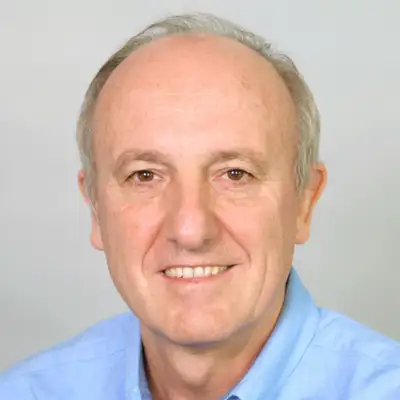
Classical Reversible Computing on Quantum Dots with Daniel Loss
Summary
What if the same hardware being built for quantum computers could also solve one of classical computing's most urgent problems — runaway energy consumption? In this episode, Sebastian talks with Daniel Loss, the theoretical physicist who co-proposed the spin-qubit quantum computer nearly thirty years ago, about his new idea: using coherent quantum dynamics in semiconductor spin qubits to perform classical reversible computation at energy efficiencies that could be five orders of magnitude better than today's best CMOS transistors. It's a provocation grounded in real experimental numbers, and it may de-risk the entire spin-qubit enterprise.Daniel Loss is RDIA Chair Professor of Quantum Computing and Director of the Quantum Center at King Fahd University of Petroleum and Minerals in Saudi Arabia, where this work was done. He is also one of the most influential theorists in quantum computing. The 1997 Loss-DiVincenzo proposal — that electron spins in quantum dots could serve as qubits — now has more than 9,000 citations and is the conceptual foundation for the semiconductor spin-qubit platforms that Intel, HRL, Diraq, and a wave of European startups are actively building toward. In 2025, Loss was named a Clarivate Citation Laureate in Physics, a designation with a strong historical track record as a Nobel Prize predictor.
The reason to listen now is that Loss has turned his attention to a question that predates quantum computing itself: can reversible, energy-efficient classical logic be physically realized? His 2026 paper argues that the spin-qubit hardware the field has spent decades developing is, almost incidentally, the ideal platform to do exactly that — and that the energy advantage over room-temperature CMOS could be so large it would matter enormously for AI inference workloads and data-center power budgets. This episode is for anyone following the spin-qubit roadmap, the energy crisis in classical computing, or the deeper question of what semiconductor quantum hardware is ultimately good for.
What We Get Into
- Why reversible computing is having a moment now: The ideas of Landauer, Bennett, Fredkin, and Toffoli have been around since the early 1980s — Loss explains what changed experimentally that makes the proposal feel like engineering rather than philosophy.
- The core energy claim, unpacked: Loss walks through why a spin-qubit Toffoli gate operating near 4 Kelvin could cost roughly 10⁵ times less energy than its CMOS equivalent, even after accounting for refrigeration overhead — and where the accounting is still incomplete.
- What makes the computation classical and the hardware quantum: The gate uses coherent quantum dynamics internally, but inputs and outputs are classical spin states. No superposition is required between gate operations, which dramatically relaxes the error-correction burden.
- The iToffoli gate and why it works for classical logic: Loss describes how a target spin hopping between quantum dots, controlled by two neighboring spins, implements a universal reversible gate using only DC voltage pulses — no radio-frequency drives required.
- The Quantum Zeno trick for classical memory: Frequent projective measurement of a spin state can stabilize it against relaxation, turning one of quantum computing's central headaches into a feature for classical storage.
- Why AI inference is the natural first application: Error tolerance, parallelizability, and the absence of a need for new algorithms make AI inference workloads a compelling early target — and Loss argues this de-risks the spin-qubit enterprise regardless of whether fault-tolerant quantum computing arrives on schedule.
- The dual-use platform argument: The same germanium/silicon quantum-dot array could, in principle, run quantum algorithms when superposition is useful and classical reversible logic when it is not — a flexibility that changes the economic calculus for building the hardware.
- What the experimental community needs to do next: Loss describes the first falsifiable tests — a three-spin iToffoli truth table, energy budget measurements, and a five-dot reversible adder — and names the groups best positioned to run them.
- How the brain comparison reframes the stakes: Loss notes that his energy estimates put spin-qubit classical computing roughly four orders of magnitude below the energy cost of a biological synapse, which has implications for how we think about the physical limits of AI.
Resources & Links
Guest & Lab
- Daniel Loss' profile at King Fahd University of Petroleum and Minerals
- Daniel Loss — University of Basel, Condensed Matter Theory & Quantum Computing Group — Loss's lab page; lists current research areas, group members, and leadership roles including NCCR SPIN.
- Daniel Loss — Wikipedia — Comprehensive biographical overview, career history, and awards list for listeners who want background before or after listening.
Papers & Articles
- Classical Reversible Computation by Quantum Coherence — arXiv:2607.06219v3 (2026) — The central paper discussed in this episode; v3 adds a reversible-adder blueprint, control-electronics energy analysis, and optimized pulse sequences.
- Loss-DiVincenzo: Quantum Computation with Quantum Dots — Physical Review A (1998) — The foundational 1997/1998 proposal that started the spin-qubit field; cited more than 9,000 times and the direct ancestor of the hardware Loss now proposes for classical reversible computing.
- Long-Range Crossed Andreev Reflection in a Topological Insulator Nanowire — Nature Physics (2025) — A 2025 result from the Loss group with implications for topological quantum computing, showing the breadth of the research program surrounding this episode's topic.
- Prof. Daniel Loss Named Citation Laureate 2025 in Physics — NCCR SPIN — Announcement of Loss's Clarivate recognition; useful context for why this conversation is happening now.
Organizations
- NCCR SPIN — National Center of Competence in Research: Spin Qubits in Silicon — Switzerland's national spin-qubit research center, co-directed by Loss; the institutional home of much of the experimental work Loss references.
- Max Planck Institute of Microstructure Physics — Loss's new external scientific membership, signaling a push to connect topological quantum magnetism theory with experiment.
Key Quotes & Insights
> "If the physical platform is successful, we are guaranteed to have killer applications — because I don't need to find new algorithms for this." > — Loss on why classical reversible computing de-risks the spin-qubit investment, regardless of the timeline for fault-tolerant quantum algorithms.
> "The energy difference is a factor of ten to the fifth. And this is mind-blowing." > — Loss summarizing the device-level energy advantage of a spin-qubit Toffoli gate over its CMOS equivalent, after accounting for refrigeration overhead.
Insight: Loss argues that the Quantum Zeno effect — the tendency of frequent measurement to freeze a quantum state — can be used deliberately to stabilize classical spin states against relaxation, turning a well-known quantum-computing obstacle into a memory-stabilization tool for classical logic.
Insight: The proposal requires superposition only inside a gate operation, not between operations. This means the error-correction burden is classical (majority voting) rather than quantum (surface codes or similar), which is a qualitatively different and far less demanding engineering challenge.
> "Whatever you develop in one form of this platform, you can benefit in the other as well." > — Loss on the dual-use nature of germanium/silicon spin-qubit hardware for both quantum and classical reversible computation.
Related Episodes
- Ep. 106 — Silicon Spin Qubits and the IBM–HRL Acquisition with Thaddeus D. Ladd — Loss mentions Thaddeus Ladd's work at HRL directly in this conversation; Ladd's episode covers the state of silicon spin qubits and the experimental progress Loss builds his energy estimates on.
- Ep. 59 — Silicon Spin Qubits with Andrew Dzurak from Diraq — A deep dive into the CMOS-compatible spin-qubit platform from one of the field's leading experimentalists; essential context for understanding the hardware Loss is proposing to repurpose.
- Ep. 74 — Majorana Qubits with Chetan Nayak — Loss has made foundational contributions to topological qubits alongside his spin-qubit work; this episode covers the Majorana approach from the Microsoft side of the same theoretical landscape.
- Ep. 13 — The Mysterious Majorana with Leo Kouwenhoven — Another angle on topological quantum computing from one of the leading experimentalists in the field, complementing Loss's theoretical perspective on the same class of systems.
- Ep. 5 — The History of Superconducting Qubits with Steve Girvin — Loss references the 2024 Nobel Prize for macroscopic quantum tunneling in superconducting devices as part of the same intellectual lineage he worked in at IBM in the early 1990s; Girvin's episode covers that history from the superconducting side.
Stay in the Ecosystem
- Subscribe on Apple Podcasts, Spotify, YouTube, or Amazon Music.
- Sign up for the newsletter at newquantumera.com — we track developments in spin qubits, topological computing, and the broader quantum hardware landscape.
- Follow us on LinkedIn and Bluesky for episode announcements and quantum news.
- If this episode made you think differently about what spin-qubit hardware is for, share it with someone working in classical semiconductor design, AI infrastructure, or quantum hardware — this conversation sits at the intersection of all three.
---
Creators and Guests