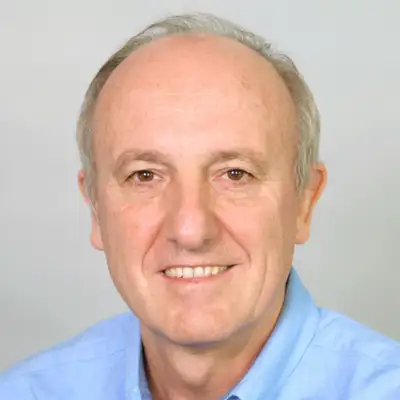
Classical Reversible Computing on Quantum Dots with Daniel Loss
Summary
What if the same hardware being built for quantum computers could also solve one of classical computing's most urgent problems — runaway energy consumption? In this episode, Sebastian talks with Daniel Loss, the theoretical physicist who co-proposed the spin-qubit quantum computer nearly thirty years ago, about his new idea: using coherent quantum dynamics in semiconductor spin qubits to perform classical reversible computation at energy efficiencies that could be five orders of magnitude better than today's best CMOS transistors. It's a provocation grounded in real experimental numbers, and it may de-risk the entire spin-qubit enterprise.Sebastian Hassinger • 00:03
A friend pointed me to a paper on the arXiv a couple of months ago, and I keep coming back to it. It proposes building ordinary classical logic gates out of quantum computing hardware — and it was written by one of the people who invented that hardware in the first place.
Daniel Loss moved a year ago to King Fahd University of Petroleum and Minerals in Saudi Arabia, and he remains a professor of theoretical physics at the University of Basel, where he directs the Basel Center for Quantum Computing and Quantum Coherence and co-founded Switzerland's national spin-qubit research center. With David DiVincenzo in 1997, he first proposed using electron spins in quantum dots as qubits. And he has spent the last year or so thinking hard about a question that is older than quantum computing. Not "how do we build a fault-tolerant quantum computer?" but something more fundamental: what is the minimum energy it should cost to perform a logical operation at all?
That question leads him somewhere surprising. His new paper proposes using the same germanium-silicon quantum-dot hardware that the spin-qubit community has spent years developing for quantum computing — and running classical, reversible Boolean logic on it. Not quantum algorithms. Classical computation. The kind of thing a transistor does, but done with coherent quantum dynamics, at cryogenic temperatures, and potentially five orders of magnitude more energy-efficient than the best room-temperature CMOS.
My first reaction was that it's a very elegant idea — and a genuinely contrarian one. So I wanted to talk to Daniel immediately.
The lineage here matters, and Loss was there for it. Loss worked at IBM Research in the early 1990s, where he knew Rolf Landauer — the physicist who first argued that erasing information carries an irreducible thermodynamic cost — and Charlie Bennett. Landauer's question about the thermodynamics of computation is what framed Bennett's work on reversible computation: if erasure is what costs you, then compute without erasing. And it was that line of thinking about reversibility that helped lead people toward the idea that quantum systems, which are reversible by their very nature, might be used to compute at all. So quantum computing is, in part, a descendant of the thermodynamics-of-computation question — and then it grew up and took all the oxygen in the room. Loss watched that happen. And now, thirty years later, with experimental spin-qubit results he can actually cite, he thinks the time is right to go back for what got left behind.
What I find most interesting about this conversation is the tension in it. The spin-qubit community has spent decades arguing that CMOS compatibility is the path to scalable quantum hardware. Loss is now suggesting that the same platform might have a near-term classical application that doesn't require solving fault tolerance first — and that having two uses for the same hardware makes the whole bet safer. If the hardware works, you get useful classical computation even before you get a quantum computer.
We get into the physics of how the gate actually works — a three-spin chain, DC voltage pulses, no radio-frequency drives — and why the computation can be classical even though the gate dynamics are quantum. We talk about where the energy accounting is solid and where it's still incomplete. We talk about what the first experiments should look like and which groups are best positioned to run them. And we talk about what it means that this proposal lands between two very different kinds of urgency: the long-term promise of quantum computing and the very immediate problem of how much electricity AI is consuming right now.
Daniel Loss is not a person given to hype. He's been in this field long enough to have seen a lot of promising ideas not pan out. So when he describes this as potentially "mind-blowing" — his word — I think it's worth paying attention to why.
Here's my conversation with Daniel Loss.
---
Sebastian Hassinger • 04:36
Daniel, hello. Thank you very much for joining me. Very nice to meet you. I've been looking forward to this conversation since I saw the paper that you posted recently to the archive. in which you propose using quantum dots, which are usually associated with the modality of spin qubits, for classical computing Which immediately grabbed my attention. it I can't I'm a sucker for a good provocation, and it feels like a good provocation. So why would you go to the trouble of
building quantum dots to do classical computing.
Daniel Loss • 05:11
Okay, so first hello, Sebastian. it's my pleasure for me actually to
And thank you very much for the you know steep introductory question. my word. It's it's a it's a very good one. And somehow you know has a long history in my thinking and also actually in the thinking of many other people in the literature But to make it short, basically I was always struck by the fact that in quantum computing and especially in quantum gates, everything is reversible. And it has to be reversible. This is you know the technical term is that the gate has to be unitary in form of a quantum operation and that translated means it's reversible so you can move with the gate forward and you can go backwards. So we don't lose any information. And in particular when you do that, and basically it's clear that you should not erase information, you should not lose information when you go forward and then going backward and that kind of you know consideration already begs the question How much energy actually does this cost? And you know, can we actually use such kind of ideas also for the standard classical logic gates. I mean this was a question which was lingering in my mind for many years. then you know I mean focus which we had on all the quantum nets and all computing basically you know didn't really allow me to pursue this idea further and when I moved to my new position here at KFUPM in Saudi Arabia a year ago, I had to prepare a course on you know advanced computing and that gave me actually a lot of time to think. about also such basic questions and I started to explore this more and more. And actually, you know, when I started to explore it I realized
This is something people have thought about to some extent just before quantum computing came. Right. This is actually very interesting. You know, when you go back in the literature, in the history, it started you know, let's say these papers documented well documented by work of Rolf Landauer, late Rolf Landauer at IBM
and basically, you know, making the point that it's hard to have a Classical computer which doesn't heat up.
This verdict was then kind of resolved. basically contradicted by his own student, by Charlie Bennett, pointing out that you can actually circumvent that kind of energy loss dissipation when you erase information. by kind of undoing the calculation in a classical reversible way. And you know, people started then to think very profoundly about that and gates were constructed, circuits were constructed, that were reversible logic. And then I think all of a sudden quantum computing hit the sea.
Sebastian Hassinger • 08:29
Right. Right. Well, in fact, there there is this there's a specific moment, right? This is a nineteen eighty-one conference at Indicod House, which was called the Thermodynamics of Computing. So they're actually there to discuss The lander invented ideas, but it sort of got hijacked by quantum computing. Exactly.
Daniel Loss • 08:45
Exactly.
The same people and all of a sudden they kind of changed the focus. And this was something, you know, I to my surprise and also to my embarrassment, I was not really aware of, because I entered the field later in mid nineties or so. And I did actually work also at IBM, Yorktown Heights, in the early nineties, so I knew Rolf and also Charlie, I know and you met Rolf Landauer at that point.
Sebastian Hassinger • 09:12
And that's when you establish the working relationship with David Di Vincenzo as well.
Daniel Loss • 09:17
Yes, yes, exactly. So this is you know when our interests came together from this different sides. So in the beginning when I was at IBM we worked on let's say more fundamental questions of macroscopic quantum tunneling, macroscopic quantum coherence. And actually you could say these were the first quantum bits people were thinking about. You know, I also say this now with this confirmation of last year's Nobel Prize given to macroscopic quantum tunneling in superconducting devices. And there also, you know, the ideas from this kind of thinking were taken over then very quickly into quantum computing You know that it's just to show you know that physics actually has very kind of you know meandering ways to go ahead to some extent. and all of a sudden, you know, just very esoteric fields become center. also for technology and for huge promises in applications. And you know, this is the beautiful thing about physics and theoretical Physics in particular, at some point you know you're just thinking about something no one else really cares about, and all of a sudden it goes into another dimension. And
That is also something I you know started then to appreciate and learn when I started to look into this question of energy. You know, what is the energy cost? of computing and yeah I had to learn, you know, I'm not the first one to think about it. but I think
My my idea and contribution now is to say that there is actually a platform
Where you know these ideas can be implemented. And it's actually you know super challenging. In the beginning I thought, oh, it's kind of an easy you know, right But there are more and more issues which are coming up, you know, at different levels. So first basic physics and then you know this system level and then you also need to make sure that you're comparing You know, apples with apples, when you talk about energy consumption because they are all done in different environments, you know, in transistor works at room temperature at the for example now spin qubit works at you know below Kelvin and you need to
That you need to pay energy also for cooling and all these kind of things and the control electronics. So there are there are many, many aspects. And it seems then I'm kind of the only one who has really given some deeper thoughts now in recent years on that. And But I think it's it's a beautiful field. So there are many, many things and open questions, I think. so I hope you know I will be joined by others in this
So now it's most of a very long you know answer to your simple question.
Unidentified speaker • 12:20
So sorry.
Sebastian Hassinger • 12:21
No, I mean th the route that I that I'm picking up is that it's really around energy consumption. And you open the paper with sort of a you know pointing out that the data centers and the expanse of AI are causing significant concerns about the energy consumption of classical computing. So from that perspective, that certainly makes sense. And frankly Also, if you look at the evolution of classical semiconductor design and fabrication, you know, we're at sort of the what seem to be potentially the limits of the sort of lithography-based you know approaches to making smaller and smaller features. you know, extreme ultraviolet makes features down to two nanometers. Two nanometers below two nanometers, everything is quantum. So it stands to reason to a certain degree that there needs to be a bottoms up sort of quantum approach to breaking those limits of classical semiconducting, right?
Daniel Loss • 13:24
Yeah, I mean that's a very good point. you know, the transistor itself, of course, is not a classical object anymore. I mean there's you know the quant mechanics also plays a role. I mean there are tunneling events taking place and so forth. But the main characteristics of A transistor to some extent is still kind of classical physics. You know, you switch from one kind of minimum to another minimum by changing a barrier and this barrier separates state zero from state one it's a very large barrier and is basically preventing thermal transitions between these two states.
And the quantum transition is completely negligible at the scale, even if it's very small. the system because it's designed that way. I mean you apply a very large barrier by the voltage and that also makes the transistor extremely stable. that's also something you know one has to appreciate. I mean I think now the current numbers are you have kind of one error per 10 to 25 operations. And then you even have to specify where you measured this. You know, this is measured now at sea level. At sea level because it's coming from cosmic race. And if you're higher up, you know, you might have slightly more and if you're less. So it's extremely stable and if you want to replace something like this, you know, that's not completely obvious how to do this. Right.
So if you switch now to you know from this kind of larger bigger object to a real true quantum object like a spin
then that's the first question and challenge you face. how stable is actually your state? So it's easy to say, you know, I have a two-state system, like for an electron spin being up and down and that's a classical state and superposition you don't want. in this game, so that's now the you know that's the big difference we don't need for the computation for the algorithm we don't need supposition but for the gate operation we need it
So if I execute an operation on my spin to turn it from up to down, then I want to use a quantum gate which is unitary and reversible. If I have two spins communicating, interacting with each other, you know, executing a C naught gate, some logical gate or toffoli gate or whatever, then I want them to interact quantum mechanics.
And so now there is the dilemma which comes that you know you can have this quantum mechanics if the object is small, but that it's difficult to have stability of the states. Because it is small. So quantum mechanics now cuts it both ways and you know one has to deal now with this kind of paradoxical situation at first sight
And so the idea is now to say, okay, can we actually use such a quantum object as a
unit which we can store, which we can use for logical operation and in particular you know where we can do universal type of classical calculations is it which requires memory which requires a fan out. So these are all kind of very big challenges. And this is what I have tried to address you know step by step
And basically trying to take off all these challenges.
Sebastian Hassinger • 17:08
So it's also very interesting.
If you're only needing superposition in very in when you're
Executing the gate for a finite amount of a very short amount of time instead of during a long-running computation as you would in a quantum computer to carry out a quantum algorithm. presumably the performance you require from your from your quantum dots is less demanding, right? The engineering required to get to that level of reliability is lower, would would you say? yes and no.
Daniel Loss • 17:43
I mean you know it's true that we do not need sophisticated quantum error correction.
between the gate operations. This is you know one of the biggest challenges for building a quantum computer to maintain the supposition, the entanglement in the system and you know that you can keep up is the noisy environment surprising that And that is a great advantage that we don't need that. I mean we also need error correction but in a classical sense and that's kind of simpler. Majority voting kind of repetition.
Exactly. And you know it's insofar important to achieve the ten to twenty-five kind of accuracy of a transistor. So no it that is kind of important. But now so having said this, there's still a challenge now. coming from the coherence. So there are two timed scales. You have to distinguish. There's the relaxation time. And that's kind of the classical time. The state goes from one to the other, let's say from a spin up to a spin down. from a zero to a one. And especially if one of the states is at the higher energy then you will have decay of that higher state to the lower state given noise and the environment, phonons, lattice vibrations, other spins, charge fluctuators and so forth in your system, and they will execute that. If temperature is kind of in energy comparable to the level splitting you have caused by magnetic field or so, then you can go both ways, you know, it c it goes up and down from zero to one non to zero. And this time scale we call relaxation time. And this relaxation time is a well-studied time for spin qubit systems, measured in many, many systems in circle. Silicon, germanium, germanium, silicon. So there are many different kind of types. it is material, it's of spin qubits. Maybe we come to this later. But this relaxation time let's say, you know, for a very good spin cubit in silicon is around thirty milliseconds
And that you know is basically the longest kind of memory time at first sight you have available. And now if you compare this, let's say with the CMOS, you know Which is eternity essentially compared to this.
Then you know this is the first challenge. However, there is now a very nice principle can exploit in quantum mechanics. we call this the c no effect. That means when you watch a system and constantly measure a system
and you measure it in let's say in some even eigen state basis up and down the set basis natural compensation axis then basically the measurement keeps the state close or actually in its initial state. So if you don't wait too long I mean if I would wait, you know, let's say my finger here is up now and I wait and then it moves away from up and you know at some point it's down. Now imagine I don't wait thirty milliseconds I wait now let's say you know a thousandth of that I wait only 30 microseconds that's a thousandth of thirty milliseconds and then I do a measurement And this measurement in quantum mechanics is projective. That means it has a certain amplitude or probability to project it into the same state or in the opposite state. But if it's very close to the original state, then the probability to object it
Project from the opposite say it's very small. So then the measurement basically with high probability protects that thing. And I don't even need to know the outcome of that measurement So I'm not recording it. I have just an you know this is also part of the scheme, but there's measurement which needs to be done, and it's this measurement which kind of maintains my memory.
Sebastian Hassinger • 21:45
Yeah.
You're turning one of the challenges of quantum computing on its head, right? I mean it's the measurement problem actually gets in the way of maintaining a coherent state in a quantum computer and you're actually using it to maintain a classical state.
Daniel Loss • 22:01
Because the system at some point actually you know wants to go into coherent position it's both. It's coherence which matters. it's a little bit more complicated with the coherence that also plays actually a role. And the decoherence also matters let's say for the gate fidelity. You know how precise can I execute the game? And that is a very important question for the error budget. And once I know the error budget, I know the energy which I need to spend on that error budget error correction and so forth. And so that is also then one of the you know kind of limitations is physics actually allowing us to get into an error budget, where I can still basically you know scale up by majority vote that I get a reliability, a fidelity which is comparable to the best CMOS. And this is a in principle possible and that is a statement now which is also based on experimental facts
So you see, the great advantage which I have now at this stage, let's say thirty-forty years after people have thought about reversible computing, is that there is a lot of experimental facts and progress out there, especially in the system now I'm looking at, to which I can resort to, to which I can build my statement. You know, I could imagine if I would have written a paper like this thirty years ago, people would just go away, you're crazy. Yeah. But now basically I can quote, you know, the experiments which have been done And they these are facts now. So these are accepted facts in the scientific literature expert. And based on those numbers one can then see whether physics allows a feasible.
Sebastian Hassinger • 23:58
Yeah. Right, right. And so you carried out a fair amount of simulation for this paper, it sounds like there you've sort of got active simulation testing these ideas and w the what's the sort of at the gross level, what's the sort of difference in energy consumption if you're doing classical computing using quantum dots versus versus standard transistor-based computing?
Daniel Loss • 24:24
Yeah. So there are actually several levels and you know it's a little bit a question of how to compare and all the different things with each other. Because they're
quite different technologies and physics background involved. Now if I say okay I take a CMOS transistor in its working environment that's 300 Kelvin and look now at the best equals transistor and take now the same with a
spin qubit. I need three of them to have a logical gate, which we call the Toffoli gate or the iToffoli gate. So that I can compare now functionalities and how much energy it costs to do. a f you know a gate, let's say like a controlled controlled knot gate or a toughly gate. And with transistors I can do that. I need you know a bunch of transistors, let's say five or ten transistors Then I look at the energy cost to switch a transistor compared to the energy cost I switch now such a spin qubit element in its
let's say you know native environment which he proposed should be around four Kelvin. We can do it at lower temperature But in order let's say now to optimize everything, I chose four Kelvin so the energy cost of cooling is less And that gives me a factor in energy difference between 300 Kelvin and 400 and 4 Kelvin, which is a factor of 100 or 150, something like this. So this is the energy which I need to pay in addition. If I do not take this factor into account, then the energy difference is a factor of 10 to 7. If I take the 100 into account, the energy difference is a factor of 10 to 5. And this is mind blowing actually. You know, because now you know let's say all the other stuff also working out nicely. We will come to this. then this means there's a potential there that you could save this kind of energy for doing the same logic. And at scale
At scale, you know, I it just means you know a data center could use a lot less energy. Now This is pushing the physical limits and just you know I mean another technical term or physics term I should mention here is the Landauer energy This you know the energy cost, the irreversible energy cost, just to erase information of a bit, you know, to restore a bit the cost energy, and that energy we measure in temperature. times the Boltzmann constant. So we call this Kt. And then there's a log two factor. It's just what we call N2P There are two states and you kind of enhance the entropy and then you reduce it when you measure and the difference is this log two times Kt. And that's Yeah, the land hour land hour energy is an important scale in the business. Abisemos person I guess knows this. And you know that is KT and this KT even at room temperature is much, much smaller than the energy cost for a CMOS for a transistor.
Sebastian Hassinger • 27:48
Right. So between the theoretical limit and the and the practical sort of operating standard operating kind of environment, there's several orders of magnitude of potential efficiency that you could gain. Exactly.
Daniel Loss • 28:03
But you know in between actually closer to the value we have now, there is what people call the Boltzmann tyranny, kind of limit. it has to do with the name, you know, that you have to go over a barrier and you know you want to suppress this. And that's a Boltzmann factor which kind of measures this in terms of inverse temperature in the exponent. And this is
A level which is around as old is given into the around ten ato chu. It's an incredibly small number, but still it's a lot. you know, it's ten to minus eighteen tools. Wow. So it's it's very small. But you know, if you have billions and billions of operations, it starts to add up. Right. And you know this is the reason why you would like to go lower. And with CMOS, I think this is what I you know hear from experts or read in the literature that's basically excluded to go below that value at room temperature. There are now attempts to have transistors also working at subcalorin, so then you can go a little bit lower. But that has all other kinds of you know demands. But anyway, so if I if I compare now these numbers then there seems to be a huge meaning.
Sebastian Hassinger • 29:21
Right. In efficiency we talk about incremental, like one, two, three, four, five percent gains. You're talking about orders of magnitude. gains. So it's it's impressive.
In terms of the performance, you know, the speed of computation, is there a trade-off there? Is this slower than we're we're Slower copy slower gate times are where you than what you're we're used to?
Daniel Loss • 29:44
Yeah. I mean here I would say that's not fundamental, but what I have now analyzed is kind of
optimizing some parameters for the performance and that is the error of a gate So basically then I ask, you know, let's make the error for certain spin qubits and I look at various
modalities, let's make that minimal and that gives me then a certain time I need to have for the gate operation. So for this I need to go a little bit more into physics if you wanna understand how this comes about. I mean there is a you know also what I need to emphasize is I want to avoid Any RF, any radio frequency so to speed now is a factor of hundred lower So we are talking about let me see here ten ten to fifty megahertz compared to a gigahertz clock speed of CMOS, but that's not a physical limit. You know, this is now optimization limit based on, I mean I rooted it in experimental numbers of current spin qubit experiments. And you know we are here on a path which constantly improves. I mean you know the progress in the field is very nice. And maybe for outsiders, you know not so visible. the PR machinery in our field is maybe less you know
potent like in other qubit modalities but the progress is really mind boggling. Actually you know when I when I checked out your podcast. I saw that you had a podcast with Ted.
And from HRL and you know he gave a very nice summary. of spin qubits and the progress there and it's it's really it's fantastic.
So the progress you know in Spin Qubits is really going fast and now
Very nice. And we can expect better and better numbers. And one of the also other principles I wanted to apply is to have the lowest possible energy consumption for a gate operation You know, just what does physics, what is the lowest possible physical limitation? And this is a baseband kind of operation, which just means you have a DC voltage on your quantum data
Quantum dot or quantum hop hopping of an electron between two quantum dots and that costs very, very little energy. It costs about twenty times or fifty times less than an RF pulse. because there's a lot of energy which goes in and out and dissipation takes place and so forth. But you now imagine so even if I would do what I propose with RF I would just have the factor of twenty or thirty more in energy consumption. So then my factor of ten to five would go down to ten to four. It would still be large. so there's a lot of room. You know, it's not that this is kind of very critical. this one thing, another thing I also want to have a native gate the iToffoli as a native gate, not decomposed into other elementary gates, because then also the delity is higher and the energy cost is lower. I mean one should also say here, it's a question what you actually wanna apply it for. And there are many many different kind of CMOS applications. And in principle, we don't need to replace all of them. You want to replace those, you know, which are most costly, and this is AI inferences And that is actually something where speed is not really so important. You can compensate for running things in parallel and you know just adding then parallel lines, okay maybe costs a little bit more of space, but it's this what drives the energy costs up and it's this well I would say I will place most of the focus now for the development of this kind of idea of reversible computing. It's also the error budget there is quite favorable. you can go up to ten percent in the output. I mean it's still a challenge, but I don't need to have you know this high precision and this high accuracy of a CMOS at its best. And so I don't need to encode error code, so I can also save there
So there are quite a number of you know areas where we could focus at and I would say the best now And it's also, you know, it's the biggest potential is application potential is AI, AI inference. So I should also emphasize, you know, the nice thing now is this. We are working on the same physical platform, Spin Qubits, and you know, we can succeed in this direction and get a quantum computer out of it. In the same platform we can do classical reversible calculations and there
This I should say, I hope no one is offended, that we are guaranteed to have killer applications. Right.
Sebastian Hassinger • 35:03
Because you know, it's I don't need to find new algorithms for this.
Sebastian Hassinger • 35:20
sort of provably more efficient quantum algorithms. But as you point out, we have all sorts of very well understood classical algorithms that could potentially benefit. from a more energy efficient and more it sounds like the more parallelizable, the more embarrassingly parallel the problem is the more likely you could apply this
classically reversible com computation using quantum dots. And the point being though, i in a way there's Not only is there sort of certainty around success or finding killer apps, like if you can if you can lower the power consumption or make make computation more efficient for known classical workloads that have value then then that's a lower risk than speculating that there's some quantum algorithm that will create the economic value that justifies the investment. And it also there's a nice symmetry there in that spin qubits themselves and your yours and Dave DiVincenzo's proposal for spin qubits in large part was motivated by the idea that if you could leverage CMOS as a platform for qubits, then you've solved a lot of the engineering challenges for scale and reliability. And manufacturability, right? Because it's such a well understood and such a successful technology. Exactly. Exactly.
Daniel Loss • 36:47
I mean, you know, I mean people talk about twenty million qubits for a computer. and you say twenty million spin qubits which have the size of a transistor. yeah, there's nothing which is scary about that number because I mean Dealing with twenty billion, the two hundred billion, you know, I was trillion.
So these numbers you know they don't mean really much. This is why a large part of I mean You know, it's in our community everyone is convinced that in the end the quantum computer will be based on semiconductors. Yeah. Yeah. I mean this there's no doubt. Because this is such a fantastic technology. you know this has been a driven to such a sophistication there's nothing comparable humankind has developed it's it's it's really mind blowing right there and I think it's it makes a lot of sense to leverage this And you know, especially for scalability. Yeah. But anyway, let me make one point more, which I just recently realized, you know, making more energy estimates. That actually the energy consumption, the cost reduction in energy consumption, is now also much lower than what the brain uses when you look up, you know, established numbers for synapse switching some functions. I mean people are still fighting, I guess, you know what is a good comparison between CMOS and energy consumption compared to the brain. But if you take the kind of accepted numbers then you know this technology this spin qubit reverse computing is four orders of magnitude below consumption of that's incredible yeah It's actually I also find it really nice because very often people also use arguments like this, the brain, you know, I mean you cannot get AI, you know, to be channel AI, also because of energy consumption, we haven't really hit it. But I don't think that is really an argument which is based on physics. You know, it's it's current technology. and here this will promise a technology which has much level. energy consumption. So I think it's kind of you know fascinating too. I just you know wanted also to say they are caveats. Of course. you know they have challenges. I'm not saying, you know, this is a you know free lunch by no means. and there are some challenges, for example, with the control. which usually also is CMOS control. And then you also have to think about, you know, how do I control my I toughly my spin qubits, you know, and execute certain algorithms. And that's also a part of my thinking. that is something people working in CMOS point out very quickly, you know, as an objection Because that's a difficult thing to overcome. But I also have you know thought supplementary not here, there's a section devoted to that, how to control such systems in a way that the energy gain is not lost. So basically you need a shared control line and distributing it to your subunits and you will get then the energy gain. being really in full effect if you have ten to five, ten to four, ten to five, let's say spin qubit units, and then you share the whole line energy by this number per qubit and then it also goes down to this energy estimate which I made. So and this is a challenge but this is not this is something people also work on for spin qubits. Because there also you need control lines and the control line you know is a problem in any qubit modality because typically a qubit needs at least one wire. And then you have many wires and we have seen these pictures, you know, IBF has come out. And that's also the great thing now of HRL, you know, to shrink everything and make it smaller. and then also to have control lines maybe where you have only one control line and you distribute it
So multiplexing, you know, this kind of the term here. And that is also something which is part of the development and that is also part of the enterprise.
Sebastian Hassinger • 41:09
Yeah, and so I mean the paper is really extraordinary. I mean it really did strike me as something, as I said, a good provocation, challenging some of the assumptions. what what do you see as the next steps? I mean this is this is a theoretical paper. Are there ways that you can start working with experimentalists to try to Test some of these these ideas.
Daniel Loss • 41:41
So the whole community was there. you know, I think they had four hundred or four hundred fifty people. How did they react? So they were kind of speechless, you know, I had all kinds of reactions. I imagine
But you know, there were some of my colleagues I had to say, look, I gave my talk at the beginning of the of the conference on Monday and I said, you know, I hope that on Friday afternoon we will have the first data because
you know it's it's it's provocative, but you know in Delft they're doing experiments, in particular in Wiener Feldhorst group, which I think is the platform best suited now to do this. And they have ticked many of the components already. So they ha you know, these are the people actually developing baseband control of spin qubits I mean also HL was doing this, but for single spin qubits, they have shown that. And you know, I'm I'm trying now to convince them that Just take four dots with three spins and show this it topily, you know, with baseband. So that would be the first step. And I think this is not really you know
a big deal I don't think. And the next step is the I mean there are a few things which need to be tested. Also I would like to see test at higher temperatures. So all experiments are done now typically at hundred millikelvin and it would be great if some of these could Be done at four Kelvin and there are experiments, published experiments. you know, SpinCube it's working at four up to nine Kelvin. So also that is not something you know I just assume. That is also rooted in experimental facts, but it's less studied and that would be great. Then the first kind of implementation would be an adder. So showing you know that you can do at the system level. A adder and you do reversible computing. I mean we haven't really talked much about it, but in this kind of algorithm, and that's the big sale, you go forward
And you read out your result and then you go backwards. Right. You all compute. So this is Bennett's contribution. to do uncomputation such that you do not need to erase any ancillas or bits and that you don't you know waste energy by doing that. And such an adder implemented in a reversible fashion It's five qubits, so I need four spins, five qubits, two iToffoli in there, C knots. Okay, I mean I would say It's doable and it would be great to implement that just to demonstrate you know proof of principle. Right. And then also have a clear budget of the energy which you pump in. Then you can actually validate. You know, this is something so far yeah people have not paid too much attention. I mean there are some experiments which have analyzed nicely energy costs again you know in a feldhorst group and also even van der zeiten did kind of budget calculations and this should be done in a more systematic way
than what has been done so far. And it's also useful for spin qubits because you know there's also an issue with spin qubits if Yeah, you're in the fridge and you don't want them to dissipate too much energy. so that error rates are not you know going up because you have heating effects and so forth. And so this type of it goes hand in hand. Yeah, this is kind of the also selling point I think of this idea that whatever you develop in one form
Sebastian Hassinger • 45:37
Yeah and that's what I think it's so it's that's what's so appealing about the idea is that as you said it sort of It de-risks in a sense the overall endeavor because there's benefits almost in every direction from this sort of line of thinking and this inquiry, right? I mean you may get better spin cubic quantum computing performance or you may end up with a solution to like high energy consumption classical computing and either would be very very beneficial.
Daniel Loss • 46:08
I mean actually that's a very nice term. de-risk. You could say you know it de-risks also the clock computing efforts. Because you could say, well, you know, even if no one comes up with you know a super great algorithm, we st we still worst case we get an order of magnitude or two of energy efficiency.
Sebastian Hassinger • 46:30
A good outcome. Yeah. Very good outcome. Well, Dave, thank you so much. Thank you for persisting through the technical issues. and thank you for joining me. I it's It is a really, really interesting paper and I suspect i you know, it may take longer than just five days for you to see an experimental result, but I would bet you that somebody's going to start implementing this in a in a lab and we'll see some results. to sort of validate your thinking. So yeah. When when that happens, we'll have you back and hopefully get to speak in on this in more depth. So thank you so much, Daniel. Yeah okay thank you all so much.
Thanks so much to Daniel Loss for joining me for this conversation. One thing he said near the end stuck with me, and I think it's the real takeaway: whatever progress the spin-qubit community makes on this platform — whether it's toward classical reversible computing or toward fault-tolerant quantum algorithms — the work compounds. The experiments that validate the iToffoli gate for classical logic are the same experiments that improve spin-qubit fidelity for quantum computing. That's a truly unusual situation in this field, where most bets are fairly binary, and I think it's one of the most compelling arguments for why this line of research deserves serious attention.
The paper we discussed — "Classical Reversible Computation by Quantum Coherence" — is on the arXiv at 2607.06219, and it's linked from the show notes. The show notes also have links to the Loss-DiVincenzo original proposal, Daniel's lab page at Basel, and the NCCR SPIN center he co-directs. If you want to go deeper on the experimental side of spin qubits, our episodes with Thaddeus Ladd from HRL and Andrew Dzurak from Diraq are both worth your time — links in the show notes.
If this episode made you think differently about what quantum hardware is actually for, please share it. The conversation about energy efficiency in computing is happening mostly in the classical semiconductor world right now, and I think it would benefit from more voices like Daniel's.
You can find us and subscribe on Apple Podcasts, Spotify, YouTube, and Amazon Music. And if you want to stay current on what's happening across the quantum landscape — hardware, algorithms, policy, and the occasional surprising idea like this one — sign up for our newsletter at newquantumera.com.
Thanks for listening. I'm Sebastian Hassinger, and this has been The New Quantum Era. Theme music by OCH. See you next time.
---
Creators and Guests